Showing posts with label games. Show all posts

Tuesday, December 10, 2019

Simple Activities Fun in Snow

“To appreciate the beauty of a snowflake it is necessary to stand out in the snow.”  Aristotle 

   
Make Your Own Path in the Snow
Dashing around for twenty minutes or holding hands and making your own path in a snowy yard is a welcome break for children and adults in winter.  The fun makes the hassle of bundling worth it.
Quick and Easy
  One simple activity is making snow faces on tree trunks. Even if snow doesn’t pack well preschool children can press hands full of snow on trees to sketch eyes, nose, ears, and smiles. They also make good snowball targets. If the snow doesn’t pack well take a plastic tub of snow into the house for 20 minutes to increase the temperature and make the snow packable. Hula hoops placed flat in the snow or leaned against a tree are also good targets for snowball toss games.
  Children can make snowballs and turn them into small 
Make Snow Faces on Tree Trunks
snowmen villages with houses, cars, dogs, trees, flowers, mountains, and rivers. Fill up some spray bottles with water and  a little food coloring. The children can add color to their villages scenes. They can make decorations or modern art paintings with stripes and geometric shapes around the back yard. You can also take cake pans packed with snow into the house and children can paint with water colors and small paint brushes.  They will blend together and make beautiful art as they melt.
Camera Action 
  You can bring a camera outside and take close ups of icicles and tree branches. Then go inside and draw with pencils on white paper or chalk on black paper. 
  Turn a cardboard box into a sled. Break it into a rectangle shape and duct tape the sled.  If there are no long hills in your yard, make one from a pile in your yard. Young children don’t need much of a decline. You can take smart phone videos of children sledding and running around for relatives 
Take Photos and Draw Icicles and Branches Later
who are far away. Teens will show you how to send them.
Snow Maze
  Turn your yard into a snow maze. Stomp down lanes of snow with dead ends. Kids can  blow bubbles and let one freeze on a wand. Can they carry it through the maze before it breaks? The maze might end at a snow house safely made out of snow balls and filled with snow furniture.
   Almost any game like tag, baseball, tennis, and catch played in the summer can be played in the winter for a short time before heading inside for hot chocolate
For more see grandparentsteachtoo.blogspot.com and Google wnmufm.org/ Learning Through the seasons live on Tuesdays at 4:30 during the NPR news break and Saturdays at 8:30 am, plus pod casts on the station’s web site. 
Photos: Fran Darling, fdarling fotos

Friday, May 17, 2019

Teaching Children’s Body Concept

Preschool Games Teach Children About Themselves
 Preschool games teach children important ideas about themselves and how to get on in the world. Remember “Head, Shoulders, Knees and Toes”? How about “Simon Says”? These activities help children identify body parts. Children are very interested in their bodies, but body parts can be puzzling to them. This science activity helps young children learn about their body parts and functions with this fun science activity. 
Body Game
 Children learn best when the activity is a game.You will need several dry sponges or baseball hats, a mirror, and some fun music with a good beat.Explain that the dry sponge or hat you have needs to be placed on the body part you name. Start with familiar parts such as the head, nose, leg, arm, and foot. Then try some less familiar ones, such as, wrist, ankle, knuckle, thumb, knee, chin, and elbow. You may wish to play in front of a mirror. Talk with your children about something that body part can do.  For example, heads wear hats.
Play Music and Pass the Sponge, Please!
  Change the pace at which you call out a part of the body. Start out slow then increase your speed. Give your children a second sponge to add to the challenge. Now call out two body parts and have your children place the sponges on the correct spots. Play some upbeat music and have walk while trying to balance the sponge on a specific body part, such as a head, hand, foot, or shoulder.  Talk about the ease or difficulty of this game and balancing the sponge. 
 Reverse Roles
  Children can call out a body part and you identify it using the sponge.  Try to fool your children and place the sponge on the wrong body part. Talk about where that correct place would be. 
  Vocabulary is very important to children’s language development. In terms of science knowledge, the body part’s name is only the beginning. What parts do are important and interesting. Be sure to talk about the function of the body part. For example, an elbow is one place where the arm bends.
Make Connections: Senses to the Body
  There are many variations. Play some music and challenge children to “clap your hands,” “stomp your feet,” and “make noise with your lips” to the music’s beat. What silly sounds can they create? 
  Teach your children to make the connection between parts of the body and the senses. Make comments such as: “Here are my eyes, they help me see. My nose and brain help me to smell. My skin helps me to feel. My ears help me to hear. My tongue helps me to taste sweet, sour, salty and bitter food.” There are also many good picture books.

 For more see grandparentsteachtoo.blogspot.com; wnmufm.org/Learning Through the Seasons; Pinterest, and Facebook.
Photos: Fran Darling, fdarling fotos
Wednesday, February 8, 2017

Helping Kids Make Sense of Numbers


Subitizing - visual number sense!
When adults look at six dots on a dice we don’t need to count out the dots.  We automatically know the dots mean six. That number sense is called subitizing.
  When young children learn subitizing, this immediate recognition leads to mastering other math skills: learning math facts, doing addition, subtraction, multiplication, division, problem solving and algebra later on. They learn that numbers are made of other numbers. The number 5, for example, is 1+4 or 2+3, and they won’t need to count each time.
  When they count larger numbers, they learn to start at a pattern they recognize immediately like 5 or 10 rather than 1 and become faster at math in their head or on paper.
Beginning Subitizing
  In Singapore, the number one country in math, families often play short math subitizing games to help children learn naturally while having fun. Parents do a few minutes here, a few minutes there while waiting in line, having snacks, or taking a walk. 
Talking Math and Having Fun
Talking math and having fun with math a little at a time make a big difference.
  You can start with numbers 1 through 5 by drawing a column of 5 attached rectangles on a piece of paper. Put one Cheerio in the first box and say “one.” Then it is your child’s turn to show “one.” Then put a cereal in each of the first two boxes and say “two.” Take turns all the way to five.
  Practice by holding up fingers and other objects. Play the same game by making rectangle box patterns found on dice and dominoes.  Once children can recognize two, three, four, five, and six dots without counting you’re are ready to play more games. This will take time over a period of days or weeks. All children are different.
 Subitizing Games
  You can play subitizing games randomly.  For example, ask children to grab and place a certain number of spoons on the table for dinner, pick out five crayons, or make a pattern of six pieces of fruit.
Make Subtilizing a Game
There are more games. Children like to play dominoes where you match dots. First, explain that an empty domino means nothing, having none, or zero. While playing, check if the children are counting or recognizing the number pattern and help them.
  Using dice, call out two numbers one through six. The odds of winning will be better if choosing two numbers. Roll the dice. If the player rolls a chosen number, he earns a penny or piece of cereal.
 Families can also purchase or make a card game of Go Fish with only dots or little fish, no numbers. More subitizing games are found on Google and Pinterest.  
Photos: Fran Darling, fdarling fotos
More Ideas and Activities....See the authors’ book “Learning Through the Seasons” at area bookstores. Also check our audio Podcasts WNMU Radio 90 Learning Through the Seasons; Youtube video activities; and join us on Pinterest

Tuesday, May 26, 2015

Kids Create Their Own Fun

Play Home-Made Hockey
Families can teach children to make their own games from material around the house. It’s an example of American ingenuity: making something from very little or changing the function to create a whole new product. This is a skill young children can be taught so they are never bored.
Teaching American Ingenuity
  Adam and Leah wanted to go fishing, but couldn’t do the real thing today. They started looking for poles, bait, line, and fish materials around the house.  They gathered yardsticks, yarn, refrigerator clip magnets, and paper clips. With help they attached the yarn, pole and magnets. They spread the paper clips around the floor in a small circle. The person who was “up” was given until the count of 5 to gather some clip fish during a turn. Then the next person took a turn.  When the magnets picked up all clips, they counted to find the winner of that round.

  The principle they used was, “ Think of a game or sport and simulate it with materials around the house.” Their game was easy, cheap, and entertaining with a little bit of learning mixed in.
  How many fishing games can your family create when the weather is foul or the real fish aren’t biting? Paper clips could be placed in a bucket of water.  A reluctant preschool child who needs to soak in the tub could have large colorful paper clips in a floating dish and use a ruler, string and magnet to fish.  The principle is still the same.
Team Creations


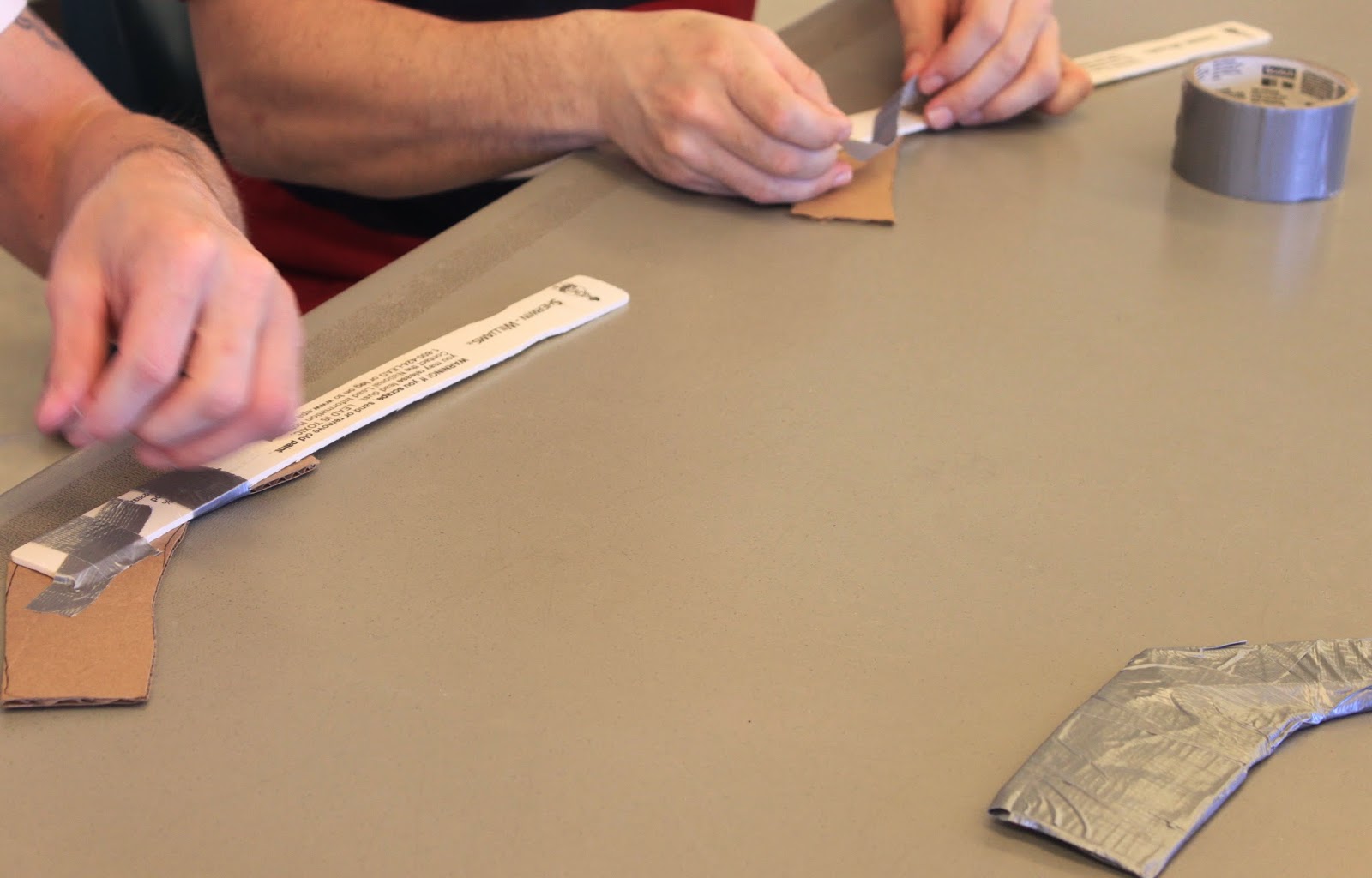
Make Hockey Sticks: Cardboard & Paint Stirs
  Another game that has many variations is bowling.  Grandma Dee was providing childcare for four little boys one rainy afternoon. She has been teaching the boys to make games plus little learning out of materials around the house. They decided to make a bowling game out of dominoes.
  Here are the rules they devised. Place dominoes face down on a table. The first player chooses ten dominoes and stands them up between the two players. The blank side faces the person who has the turn. This player lays a domino about one foot away from the standing dominoes and flicks it to knock down as many dominoes as possible. When all dominoes are knocked down, the dots are totaled and the next person chooses a different set of ten and takes a turn. The grand kids worked as a team to create a new game from materials around the house. A little bit of math was worked into the fun. Mission accomplished.

Hit the Tape Spool Puck
  Parents and grandparents often think back to their childhood when they created their own games and other entertainment. Today’s children can do the same. There is never boredom when children learn to create their own fun and learning.
 Photo: Fran Darling, fdarling fotos

More Ideas and Activities....See the authors’ book “Learning Through the Seasons” at area bookstores and grandparentsteachtoo.org. For more help to prepare young children for success in school see the authors’ web site: www.grandparentsteachtoo.org. Also check our audio Podcasts WNMU Radio 90Youtube video activities; and join us on Pinterest