Showing posts with label geography maps neighborhood. Show all posts

Friday, April 8, 2016

Giving Kids Sense of Place

Take a Walk: Give Children a Sense of Place

As the weather improves, families find it easier to get outside to give children a sense of place. Most children no longer have the experience of playing freely outside in the neighborhood. They interact with impersonal places like stores or with technology and virtual environments instead of their natural environment.  National Geographic reports researchers found that 70 per cent of Mothers played outside every day as children; now only 31 per cent of their children play outside every day in their neighborhood.
What is Sense of Place?
  According to geographers, a sense of place is understanding what makes a place special and unique.  It grows from identifying oneself with a particular piece of land.  It is a feeling of home, belonging, and attachment. It is the feeling when after being away one returns to the smell of trees, beautiful sunsets, sounds of wildlife or street sounds and realizing this is home. “I remember!”
  According to researchers Pamela Brillante and Sue Mankiw it is important to imprint children’s sense of place in the real world during an age of virtual reality video games. Children need to get back on track.
Real, not Virtual World
 Children do not develop this sense of belonging by themselves. They need adults to guide them. Families can take children outside for even a thirty-minute walk and make a difference.
  Walk somewhere—the library or around the block. Notice the trees.  Touch the different barks.
Use Your Senses: Smells, Touch, Read the Signs
  Smell the flowers and look at the sidewalks.  Are there anthills?  Are animals making sounds? Point out human and animal houses in the neighborhood.  Is there a fallen tree they want to climb? How deep is this mud puddle?

  Stop and talk to neighbors working in their yards.  Read signs.  Stop, look, listen, touch, smell, collect, and take pictures.  Give children the words they will later use to explain the experience.
  Take a walk downtown. Is there a bakery or coffee shop to visit? Describe what busy people are doing.  Are they delivering goods?  Are they helpers like police officers and fire personnel?
   Walk on a country road or visit a park. Check out plants growing.  Climb some hills or fallen trees. Children can use the ideas to draw pictures with labels when they get home.
  Children’s awareness of relationships between people in their environment and how the children fit in
Create Awareness of Surroundings 
is crucial. They will remember certain places based on sensory information and the words adults use. It is a sense of contentedness
and belonging. These children see themselves as more capable social beings and ready for school. (YI-Fu Tuan) Good books include “The Listening Walk” by Paul Showers,“Alphabet City” by Stephen T. Johnson, “Around the Pond:Who’s Been Here “and “In the Woods: Who’s Been Here?”by Lindsey George, and “Sam and Dave Dig a Hole” by Mac Barnett. 
photos: Fran Darling:  fdarling photos
More Vocabulary Ideas and Activities....See the authors’ book “Learning Through the Seasons” at area bookstores and grandparentsteachtoo.org. For more help to prepare young children for success in school see the authors’
website: Also check our audio Podcasts WNMU Radio, 90; Youtube

Monday, March 14, 2016

Making Maps with Plastic Eggs


Young Children Construct Maps With Blocks
Children are naturally eager for knowledge. With a little preparation, families can have fun together providing a learning environment and inviting discovery. Map making activities are fun and help develop a sense of order.
   When young children play with snap together blocks on the floor, they can construct rooms and furniture for their tiny play figures. Explain that they can also look down on the room and draw a picture map of all the furniture, doors, and windows with lines, rectangles, and squares. They can make circles to represent their play figures.
  You don’t need to do this every time they construct, just when they are in the mood. Making maps may become a habit when they build.
Treasure Maps
  Another time help them draw a simple paper treasure map of their bedroom. Draw some ovals where you plan to place plastic eggs. Explain that if they were Spiderman stuck to the ceiling, this is what they would see.
  Then walk around the room while

Learn and Explore Through Mapping
following the map and place the eggs. Use words like ”turn right and walk around the chair” to practice directions. Add a map key and  a title “My Bedroom Treasure Map”
  Together you can make more treasure maps and include eggs for others to find.  Place the plastic eggs under and behind objects around the bedroom so the seeker must follow the map.
  When young children feel like playing
map games again, help them draw a treasure map of more rooms. Keep the maps very simple and hide eggs where others will need to follow the map instead of taking one look and spotting the eggs.
Fun with Maps
   Together make treasure maps of their room’s
See Your Neighborhood in Google Street View
location in the house and their house on the street.  Introduce other kinds of maps of places they visit. Show them where Santa lives on a world map or globe and draw a line to their house. Children might also like to see locations on Google Maps.
  Other helpful places include: ”Follow That Map” by Richie, “Me on the Map" by Sweeney.
Photo by Fran Darling, fdarling fotos
Sketch by Mark Nowicki;
Street View, Google Maps

More Ideas and Activities....
See the authors’ book “Learning Through the Seasons” at area bookstores and grandparentsteachtoo.org. For more help to prepare young children for success in school see the authors’ web site: www.grandparentsteachtoo.org. Also check our audio Podcasts WNMU Radio, 90; Youtube video activities; and join us on Pinterest

Saturday, October 10, 2015

Riding Google Maps Magic Carpet

Practice First
Take a magic carpet wide with children and Google maps. You will need an ordinary rug for a magic carpet, a computer, and Google Maps found by typing it in the Google search window.
  Explain that it’s time for imaginary magic carpet rides like the ones Aladdin takes.   Sit on a rug and pretend you are going around your neighborhood high above the trees rather than in the car. Lean to the right and left to make a turn and dodge trees, dogs, or any obstacles children can imagine.
  When it is time to use Google Maps with children use a laptop rather than a desktop, if possible. Bring it on the floor to the magic carpet so the experience is more realistic. Some grandparents have magic couches if the floor is a bit too low for the knees.
Practice First
 Navigating Google Maps may take a little practice before playing with children. Go to Google.com.
Type in an Address
Type in Google Maps in the search rectangle.
  Click on Google Maps and type your house address into the search rectangle in the upper left of your screen. Then click on the search magnifying glass. Click on the satellite picture on the lower left of the screen to see a satellite view.
  Explain to children that you are all going on a magic carpet ride to look at their house the way a bird sees it and pretend to drop a heart picture on the steps.
 Show your children the map that appears. You will see an aerial shot of the neighborhood with trees, roads, and water features.  Click the plus sign on the screen’s right side several times to see a close up of the rooftops. Click on the screen and move the mouse very slowly to get the feeling that you are hovering over the rooftops.  Find your house and pretend to drop the love note.  Family members might place the exact message on the doorstep ahead of time and later children can find it.
Find Famous Spots
   Slowly move the mouse arrow around to travel down the street to landmarks children might recognize like a playground, school, or parking lot.
Street names will usually be labeled making it easier to follow a route. If you’re lucky, there may be cars in driveways or parking lots.
Find Famous Spots
  Continue moving the screen to find a gravel pit, river, or lake. Children will be able to see the light colored shallow water and the darker deeper water. They will also enjoy seeing Glacier National Park, the Grand Canyon, Disney World, the White House, or relatives’ houses around the world. Satellites and thousands of planes crisscrossing the Earth have taken these images.
Screen Shots: Google maps
More Ideas and Activities....See the authors’ book “Learning Through the Seasons” at area bookstores and grandparentsteachtoo.org. For more help to prepare young children for success in school see the authors’ web site: www.grandparentsteachtoo.org. Also check our audio Podcasts WNMU Radio, 90; Youtube video activities; and join us on Pinterest

Monday, May 18, 2015

Geography Fun Helps Preschool Kids


With a rug and a few
 Ready to Travel in Newly Built Cities
small cars and trucks, families can teach geography and economic concepts that will be used throughout their lives.
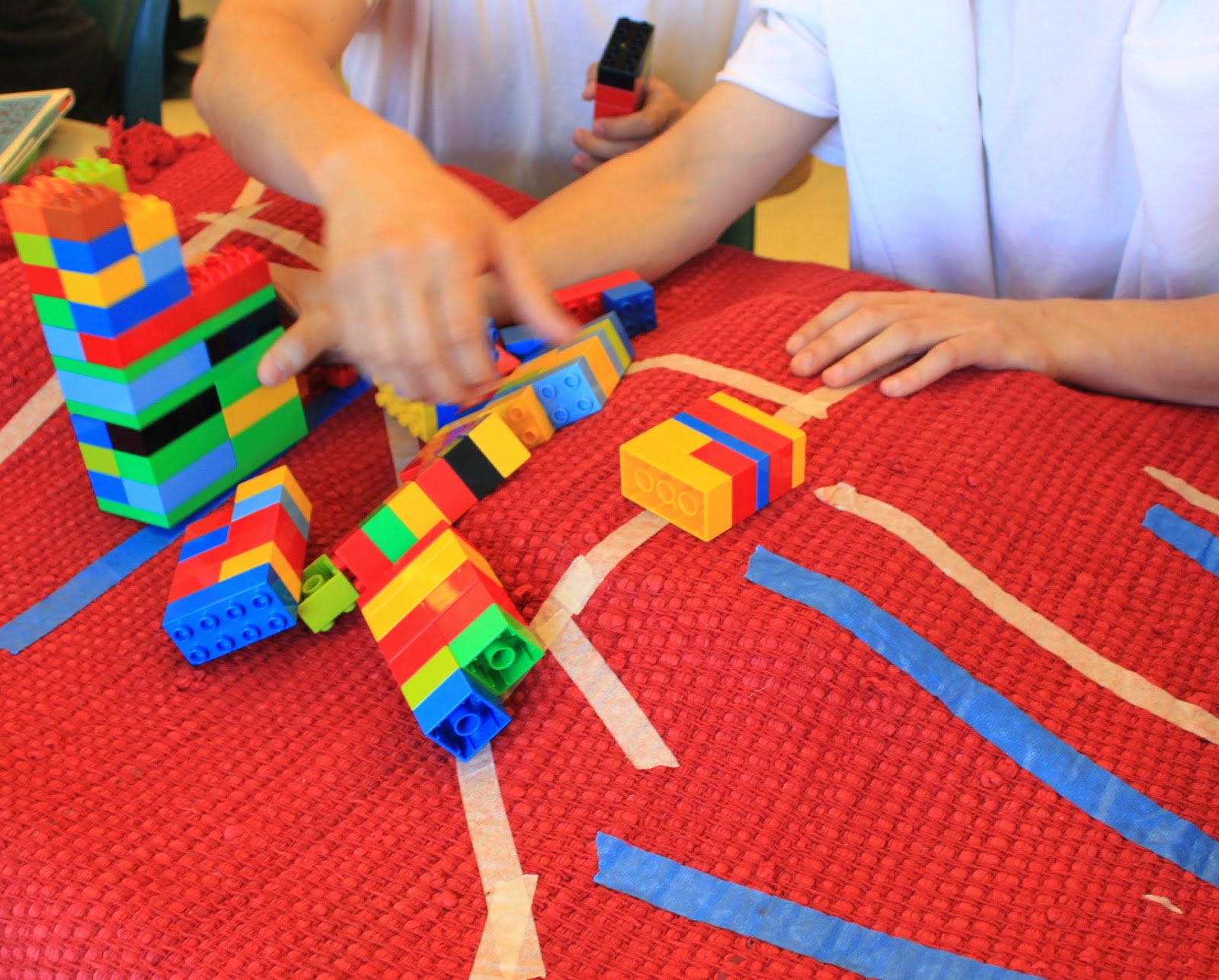
 To make the geography rug gather a relatively smooth large rug, small cars and trucks, plastic animals, Lego type blocks, blue and tan masking tape, towels and shoes. 

Build Hills & Valleys
Making the Scene
  Spread a rug on the floor or table. Explain to children that they will be making a town. The location may be real or imaginary. What will the place look like?  Are there hills and valleys? Are there rivers and lakes? Older children can make a topographic rug map of the United States with the mountain, Great Plains, rivers, and cities.

  Explain that land is not usually flat. There are geographic features on the place like hills, mountains, and rivers. Tuck towels and shoes underneath the rug to make these bumps with valleys between. Cake pans or plates underneath can make plains.
Add rivers with blue masking tape. Point out to
Build Lego Buildings
children that rivers flow down hill and end in the lowest point. Children can cut out lakes and ponds from blue paper.
 Add Human Features
   Create features humans have added to their environment. Tan masking tape can be paths, streets, and highways.
  Help children make a list of the buildings and other places they can make from Lego–type blocks and cardboard like stores, hospitals, schools, churches, parks, homes, and bridges. Add them and any small plastic animals you may have to the rug.
   How are people going to interact with each other and their environment in the city you have created? Is the grocer out of oranges and calling for a truck to bring them to the store? There are many stories to create adding action to play time.

Add Cars, Planes, Trucks
  There is constant movement. Trucks carry fruits, vegetables, milk, lumber and cars from one location to another.  Garbage trucks carry wastes to landfill. Fire trucks, ambulances, and police come to the rescue when there are accidents.  Sometimes police hand out speeding tickets.
  Where are people going? Do some need help? Are roads blocked and need repair or plowing? Use cotton balls for snow. Ask is this place like other regions?
  When children are finished, the geography/economic rug can be stored in a container for next time.
 Richard Scarry’s Busy Town books are excellent to introduce economics, and community helpers for this activity. Libraries have many books to help families teach more about the Five Themes of Geography: location, place, human relationships with the environment, movement, and regional similarities and differences that are also taught in schools. While on family trips use the Five Themes to teach all about the areas visited. This is a great way to organize pictures for a family vacation book.

photos: Fran Darling, fdarling fotos
More Ideas and Activities....See the authors’ book “Learning Through the Seasons” at area bookstores and grandparentsteachtoo.org. For more help to prepare young children for success in school see the authors’ web site: www.grandparentsteachtoo.org. Also check our audio Podcasts WNMU Radio 90; Youtube video activities; and join us on Pinterest

Wednesday, November 20, 2013

Where in the World Do I Live?


Map exploration can be used to show where a child lives and teach geography.
Materials:
map of your area (often found in a phone book)
state map U.S. map world map globe
What to do:
Using the local map, find your child’s street. Point out familiar sites like the library, grocery store, a park, or a museum. Talk about your street and the city where your child lives. Help your child learn the home address by repeating the street name and the city often.
On another day use the state map and show where your city is on the map. Use the state map to point out some familiar sites like a local lake. Practice saying the address and now add the state.
Use another day to show the U. S. map and point out your state. Point out a few interesting places, such as Disneyworld, where the President lives, or a state with lots of sunshine. Talk about the oceans that border the shores of our country. Again practice the address and this time add our country.
Using the map of the world, find our country and backtrack to find the state and city (if possible). Use the globe to discuss that the earth is not flat. Point out where Santa lives
and the route he takes to get to your house. Point out the other side of the world where penguins live.
How will this help young children?
Young children get a glimpse into the big picture of the world. It introduces maps and how to use them.
What else can I do?
Google® maps and show your child the world, state, city and street from space. Zoom in and find your house. Libraries have many books about maps, your area, state and country.
Daevin Scillian’s P is for Passport: A World Alphabetisagreatone.

Watch similar activities on YouTube. Click to view a video with more mapping and model road building activities… While there, you can find other videos on YouTube there or search for Grandparents Teach, Too in YouTube.

Also look for more activities on our website: http://grandparentsteachtoo.org and listen to activities from WNMU Public Radio 90 podcasts at http://wnmufm.org/learningthroughtheseasons 

Picture by Mark Nowicki