Sunday, January 19, 2014

Children’s Pie Crust in a Bag


 Young children enjoy being a part of any special preparations.  Holidays may be over, but as the long winter months roll on, making something special for family meals is a great way to share and create. Children shine when praised for cooking projects.  For easy mess-free cooking, make piecrust recipes in a sealable bag.

Ingredients:
2 1/2 cups all-purpose flour, 2 tbsp. sugar, 1/4 tsp. salt, 1/2 cup cold butter, cut into 1/2-inch pieces, 5 tbsp. cold vegetable shortening, 8 tbsp. ice water
 Directions: Help children measure flour, sugar, and salt into a sealable gallon plastic bag. Seal and shake to combine. Add chilled butter pieces and shortening to the bag. Press down and flatten the bag with palms to mix well and produce a flaky layered crust.
  Open the bag and add ice water. Reseal, press, and shake until the dough holds together (add more water, if necessary). Take out of the bag. Turn the dough onto a lightly floured surface and knead together. Divide in half, flatten, wrap in plastic, and chill for 30 minutes.
  Roll out one of the disks on a lightly floured surface until you have a circle that's about 12 inches in diameter. Line a 9-inch pie plate with the dough. Trim any extra from the edges with a sharp knife (adults only). Return to refrigerator ready for the pie. Makes 1 double crust.

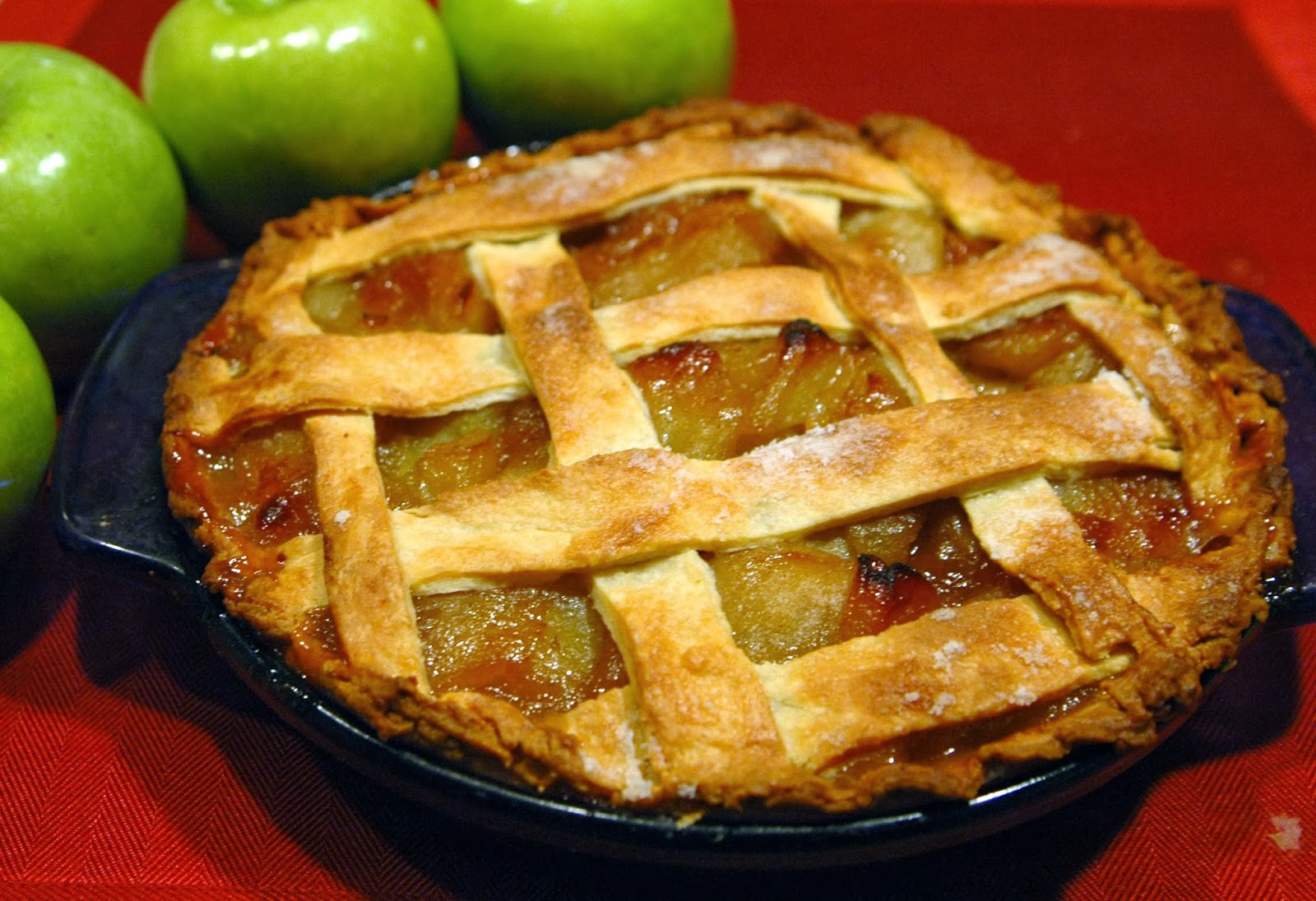
Children’s Apple Pie
Ingredients:
 8 Granny Smith or Cortland apples, juice of 1/2 lemon, 3/4 cup sugar, 1 tsp cinnamon, 1/4 tsp. nutmeg, 2 tbsp. all-purpose flour, pie crust, 2 tbsp. butter, cut into chunks, milk for glaze

Directions:
  Preheat oven to 425 degrees. Once adults peel the apples, younger children may cut apples into ¼ inch pieces with a table knife. Place apples in a large mixing bowl or sealable bag. Pour the lemon juice over apples; add sugar, cinnamon, nutmeg, and flour. Toss well. Empty the spiced apples into the lined piecrust and dot with butter. For a lattice top crust, children cut 14 long strips out of the second piecrust. Working from the middle of the pie toward one side, fold back every other strip. Lay a cross strip across the remaining flat strips. Return the folded strips, then fold back the alternate strips and lay in the next crosspiece. Continue, creating a weave pattern. When one half of the crust is woven, repeat with the other side. Children use thumb and index finger to crimp the edges. Brush the top with milk for a shiny glaze.
  Bake for 45 minutes (with a cookie sheet on the rack below) until crust is golden brown and you can see the juices bubbling. If the crust browns before the pie is fully baked, cover with foil until time is up. Cool pie before slicing into wedges.

For more help to prepare young children for success in school see the authors’ web site www.grandparentsteachtoo.org.
Also check our audio Podcasts WNMU Radio 90; Youtube video activities; and join us on Pinterest.
Photos: http://www.flickr.com/photos/dan90266/42759561/   http://upload.wikimedia.org/wikipedia/commons/a/ad/Apple_pie_filling_arranged_in_the_crust.jpg


Thursday, December 26, 2013

Use Pebbles and Pasta for Graphing Fun


Graphing helps children look at numbers in different ways. Starting children with graphs when they are young helps them count items quickly, organize, compare, and discuss information. Using different items makes graphing fun. 

Materials:  Four varieties of pasta, beans, or stones, paper, crayons, pencil, and a small bag

What to Do:
   Explain to your children there are different kinds of graphs and you are going to be using a bar graph. These graphs help people actually see comparisons between numbers of items.
   On one sheet of paper make a graph that has the same size boxes of four columns with ten rows in each column. In each bottom box, draw a simple illustration of the chosen pasta, bean or stone. Explain that each row going across and each column going down in a graph is called an axis.
  Place no more than ten pieces of each type of pasta, bean, or stone in a bag.  Help your children sort the items based on characteristics like color, shape, size, or texture and count each group.
 Children can place each item in a box above the correct picture. Talk about what the graph looks like. Does one kind have more? Which kind the least amount? Are there any that are equal?  Your children can then color a box as a piece of pasta is removed. Older children can color the correct number of boxes after counting each group. Be sure to have a conversation about what the graph is showing.  On another paper children can dictate sentences about the graph using words such as more, less, and equal. Tape the papers together and tape them to the refrigerator to share with other members of the family.

 
How Does This Help My Children?
  Your children are seeing numbers in a different way. A graph is a great tool to explain math concepts like more, less, and equal. Children are counting and working with one to one correspondence as the item is counted and then placed on the box of the graph. Graphing is a good way to see different groupings as well. By using correct math terms you are teaching math vocabulary that is necessary for school success.

What Else Can I Do?
 Try flipping the graph so that the boxes extend horizontally. Does it show the same information?  Is it just as easy to see which item has more, less or is equal?  Add a different shape of pasta and be sure to add another column for that shape. How does that change the information? A few good books to read with your children that explore graphing and different kinds of graphs are:” The Great Graph Contest” by Loreen Leedy, “Lemonade for Sale: Bar Graphs” by Stuart J. Murphy and “Graphing Favorite Things” by Jennifer Marrewa.

More Fun: For more math fun see the authors’ books “Learning Through the Seasons” available at bookstores, museums, and our website. Also check out more activities for fun on the WNMU Learning Through the Seasons Podcasts and Grandparents Teach Too YouTube videos

Picture: Mark Nowicki  Photo: Fran Darling

Wednesday, November 20, 2013

Where in the World Do I Live?


Map exploration can be used to show where a child lives and teach geography.
Materials:
map of your area (often found in a phone book)
state map U.S. map world map globe
What to do:
Using the local map, find your child’s street. Point out familiar sites like the library, grocery store, a park, or a museum. Talk about your street and the city where your child lives. Help your child learn the home address by repeating the street name and the city often.
On another day use the state map and show where your city is on the map. Use the state map to point out some familiar sites like a local lake. Practice saying the address and now add the state.
Use another day to show the U. S. map and point out your state. Point out a few interesting places, such as Disneyworld, where the President lives, or a state with lots of sunshine. Talk about the oceans that border the shores of our country. Again practice the address and this time add our country.
Using the map of the world, find our country and backtrack to find the state and city (if possible). Use the globe to discuss that the earth is not flat. Point out where Santa lives
and the route he takes to get to your house. Point out the other side of the world where penguins live.
How will this help young children?
Young children get a glimpse into the big picture of the world. It introduces maps and how to use them.
What else can I do?
Google® maps and show your child the world, state, city and street from space. Zoom in and find your house. Libraries have many books about maps, your area, state and country.
Daevin Scillian’s P is for Passport: A World Alphabetisagreatone.

Watch similar activities on YouTube. Click to view a video with more mapping and model road building activities… While there, you can find other videos on YouTube there or search for Grandparents Teach, Too in YouTube.

Also look for more activities on our website: http://grandparentsteachtoo.org and listen to activities from WNMU Public Radio 90 podcasts at http://wnmufm.org/learningthroughtheseasons 

Picture by Mark Nowicki

Sunday, November 17, 2013

Spanish Podcasts Now Posted

Listen to many of our Grandparents Teach Too activities in Spanish!!

We just added a new podcast page on our website that has a small library of wonderful, fun AND educational activities. Listen and enjoy such topics as: Composting With Kids, Playing Games With Teaching Strategies, Reading Matters, Talking With Your Infant and five more... Go to our website Grandparents Teach, Too Podcast page to listen to them all!
Remember you can hear many more English version podcasts posted at WMNU Learning through the seasons Podcast pages. 

Carey, Chris. bookbasket.jpg. Orlando Florida. Pics4Learning. 17 Nov 2013